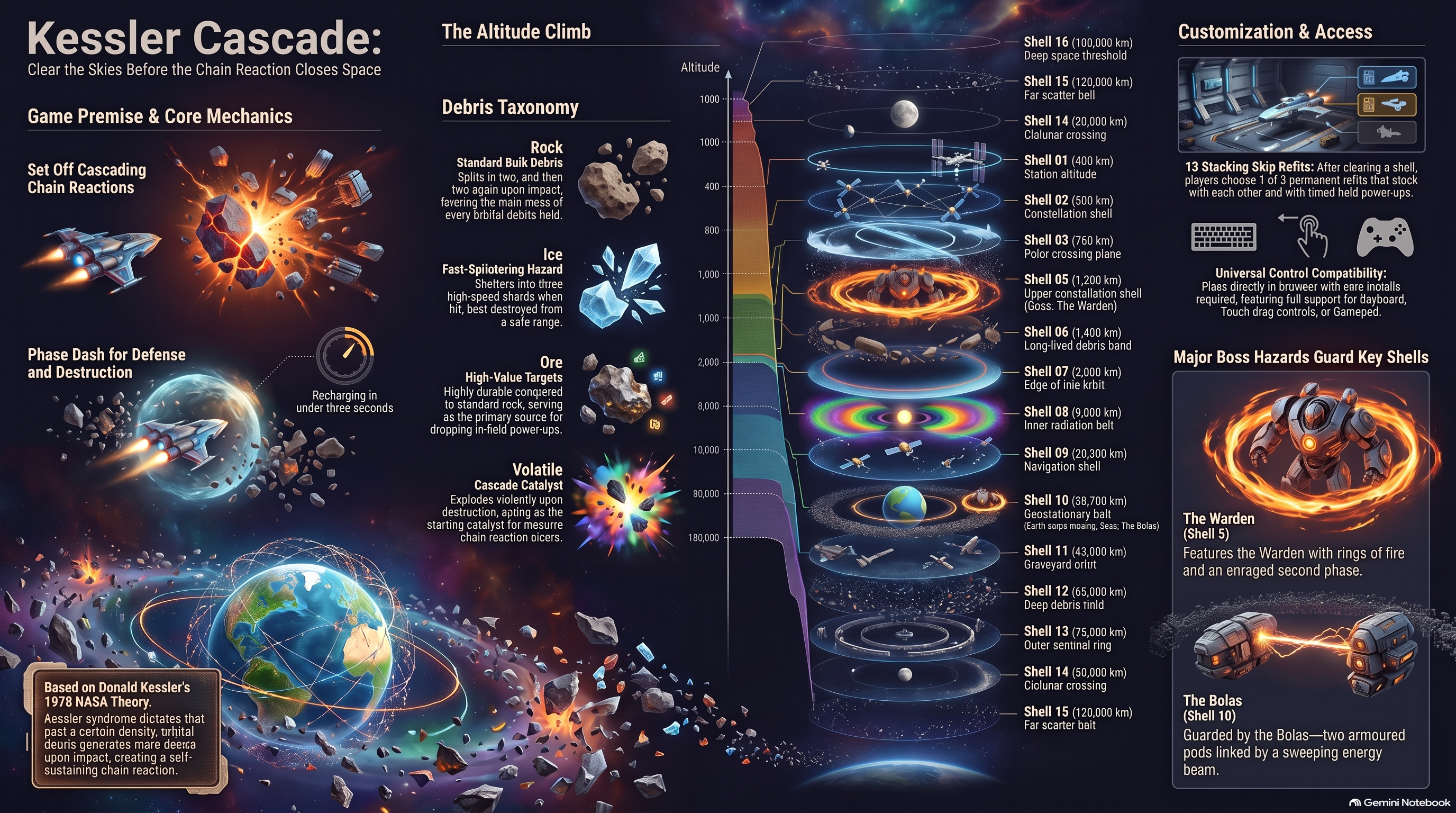
Past a certain density, debris in orbit makes its own debris. Every impact seeds the next.
In 1978 NASA scientist Donald Kessler described how a crowded orbit could tip into a chain reaction of collisions. The idea carries his name: Kessler syndrome.
Kessler Cascade hands you the cleanup job. It takes the bones of the 1979 arcade classic, a ship, inertia and rocks that split, and builds a modern run-based game on top.
Thirty seconds to learn. A long climb to master.
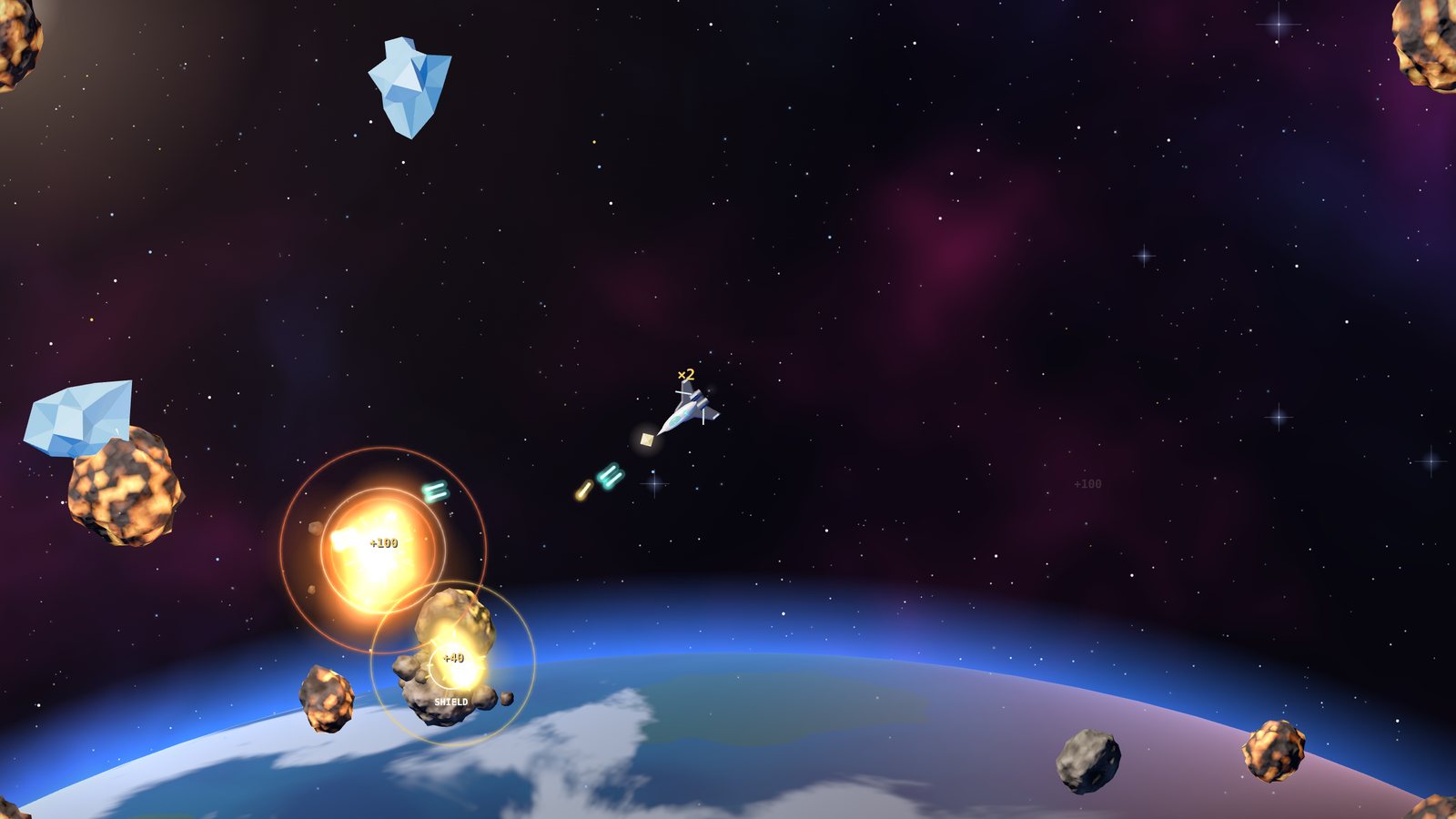
Set off the cascade
Ember-veined debris detonates when it breaks, and the blast takes its neighbours with it. Line up a chain and the whole field goes in one move. Stand too close and so do you.
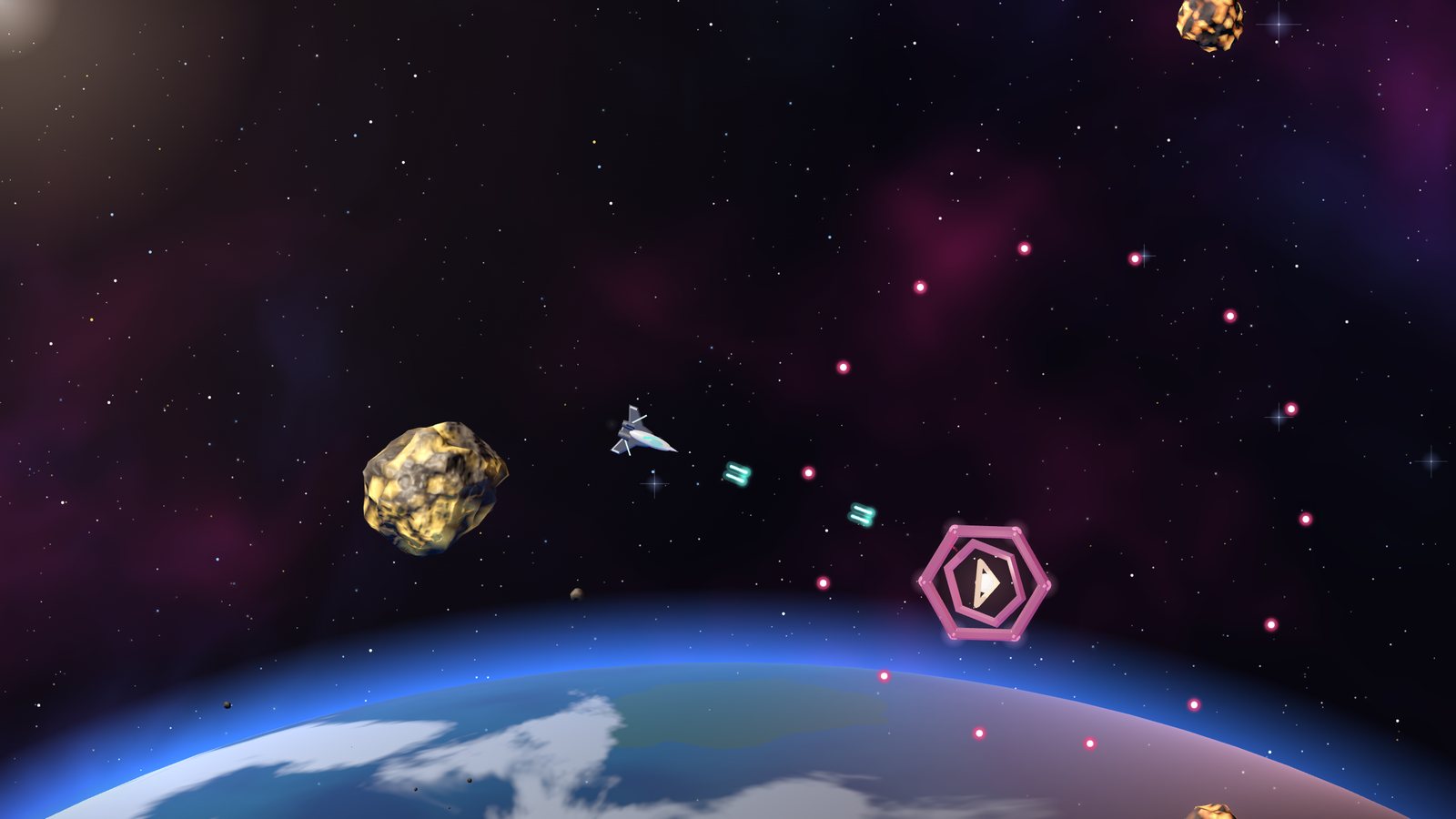
Dash straight through it
Press Shift to phase dash. For a moment nothing can hit you, and any rock in your path is rammed apart. It recharges in under three seconds, so use it often.
You will need it on shell 5, where the Warden waits with rings of fire and an enraged second phase.
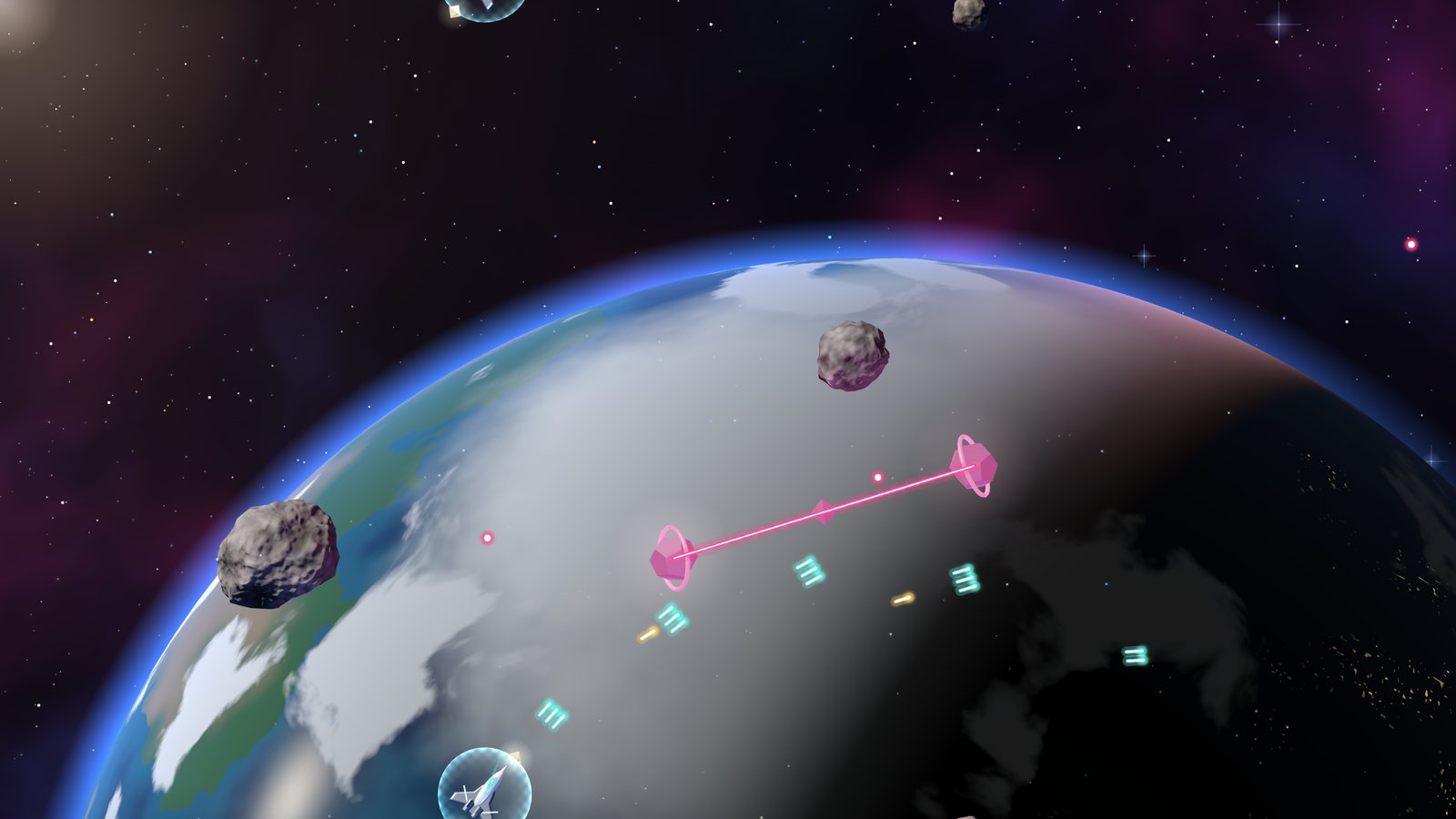
Mind the beam
The Bolas guards shell 10, the geostationary belt. Two armoured pods are tied together by a beam that sweeps the field and reverses without much warning. Shoot the pods. Dash through the beam.
Four kinds of rock. Four ways to deal with them.
These are the live models from the game, tumbling in the same light.
- Rock
Splits in two, then two again. The bulk of every field.
- Ice
Shatters into three fast shards. Hit it from range.
- Ore
Tougher than rock, and the best source of power-ups.
- Volatile
Explodes when destroyed. The start of every cascade.
Every shell is a real altitude.
You start at 400 km, where the space station flies, and work outward. The Earth below shrinks with each shell, sized from the true geometry, and it drifts past at orbital speed.
At 35,786 km it stops moving. That is geostationary orbit, where a satellite keeps pace with the ground.
Beyond shell 10 lies graveyard orbit, and the shells keep coming.
- 400 kmStation altitude
- 550 kmConstellation shell
- 780 kmPolar crossing plane
- 865 kmFragmentation field
- 1,200 kmUpper constellation shell
- 1,400 kmLong-lived debris band
- 2,000 kmEdge of low orbit
- 8,000 kmInner radiation belt
- 20,200 kmNavigation shell
- 35,786 kmGeostationary belt
- 42,000 kmGraveyard orbit
- 55,000 kmDeep debris field
- 72,000 kmOuter sentinel ring
- 90,000 kmCislunar crossing
- 120,000 kmFar scatter belt
- 180,000 kmDeep space threshold
Clear a shell, choose one of three.
Refits last the whole run and stack with each other and with the timed power-ups that drop in the field. No two builds end up the same.
Keyboard, touch or gamepad.
Keyboard
- Turn
- ← → or A D
- Thrust
- ↑ or W
- Fire
- Space
- Dash
- Shift
- Pause
- P
- Sound
- M
Touch
- Steer
- Drag anywhere
- Thrust
- Drag further
- Fire
- Hold Fire
- Dash
- Tap Dash
Gamepad
- Steer
- Left stick
- Thrust
- Left trigger
- Fire
- A or right trigger
- Dash
- B, X or a bumper
- Pause
- Start
Clear the sky.
Play Kessler CascadePlays in your browser with nothing to install. Best with sound on.